
Autism and Communication Issues: Understanding Challenges and Effective Solutions
Autism Spectrum Disorder (ASD) affects how individuals perceive and interact with the world, with autism and communication issues standing out as one of the most common hurdles. For many children and adults on the spectrum, expressing needs, understanding social cues, or engaging in back-and-forth conversation doesn’t come naturally. If you’re a parent, educator, or caregiver navigating these challenges, you’re not alone—about 1 in 36 children in the U.S. is diagnosed with autism, and communication delays impact nearly 50% of them profoundly.
This article breaks down the core aspects of autism and communication issues, explores why they occur, and highlights proven strategies like speech therapy and ABA (Applied Behavior Analysis) to foster meaningful connections.
What Are the Key Communication Challenges in Autism?
People with autism often face a spectrum of communication difficulties, ranging from nonverbal expression to subtle social misunderstandings. These aren’t due to a lack of intelligence but stem from differences in brain wiring.
-
Delayed or Absent Speech: Around 25-30% of autistic individuals remain nonverbal or minimally verbal into adulthood. They might rely on gestures, sounds, or pictures instead of words.
-
Echolalia and Literal Language: Repeating phrases (echolalia) or taking idioms literally—like interpreting “it’s raining cats and dogs” as a real event—creates barriers in fluid dialogue.
-
Social Communication Gaps: Difficulty reading nonverbal cues, such as facial expressions or tone, leads to misunderstandings. For instance, an autistic child might not grasp sarcasm or know when to take turns in conversation.
-
Pragmatic Language Struggles: This involves the “unspoken rules” of talk, like maintaining eye contact, staying on topic, or adjusting volume in different settings.
These autism and communication issues can lead to frustration, isolation, and behavioral outbursts, but early intervention changes the trajectory dramatically.
Why Do Communication Issues Arise in Autism?
At its root, autism involves atypical neural processing in areas like the amygdala (emotions) and prefrontal cortex (social planning). Genetic factors, prenatal influences, and environmental triggers play roles, but the hallmark is impaired joint attention—sharing focus with others—which is foundational for language development.
Research from the CDC and Autism Speaks shows that without support, these issues persist, affecting relationships, school performance, and employment. Picture a child who wants a snack but can’t verbalize it, leading to meltdowns; targeted therapies bridge this gap effectively.
Proven Therapies to Overcome Autism and Communication Issues
The good news? Evidence-based interventions can unlock communication potential. Here’s how key therapies address autism and communication issues:
Speech-Language Therapy (SLT)
SLT tailors exercises to build vocabulary, articulation, and social skills. Techniques include:
-
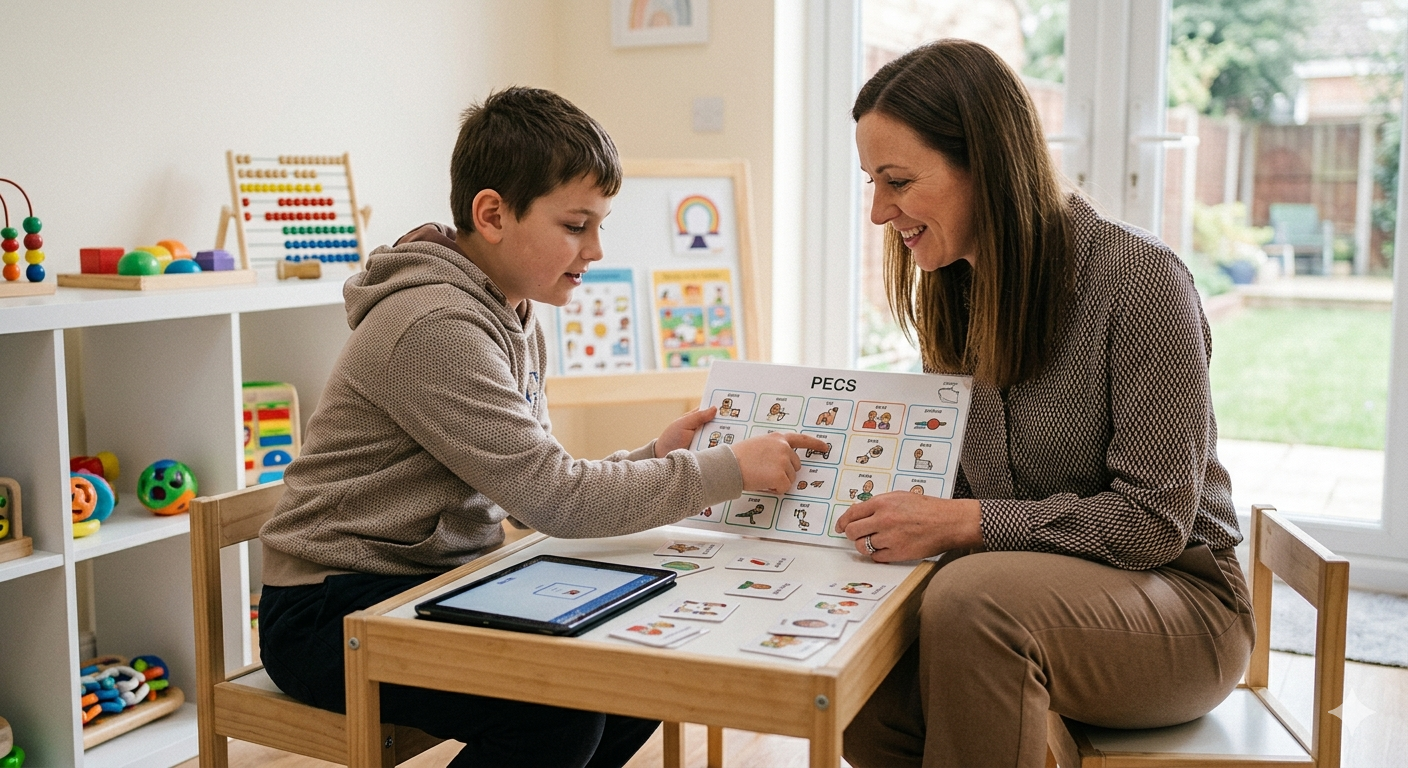
Picture Exchange Communication System (PECS), where kids trade images for needs.
-
Augmentative and Alternative Communication (AAC) tools like apps (e.g., Proloquo2Go) for nonverbal users.
Studies in the Journal of Autism and Developmental Disorders report 70% improvement in expressive language after consistent SLT.
Applied Behavior Analysis (ABA)
ABA breaks communication into small, rewarding steps. A therapist might reinforce eye contact during “hi” exchanges, gradually building sentences. Discrete Trial Training (DTT) and Natural Environment Teaching (NET) make learning fun and functional.
Occupational and Behavioral Therapies
Occupational therapy enhances sensory integration—crucial since many autistic individuals are hypersensitive to sounds or textures that disrupt speech. Pairing it with behavioral therapy promotes emotional regulation for clearer expression.
Early start is key: The earlier intervention begins (ideally before age 3), the better outcomes, per NIH data.
Practical Tips for Supporting Communication at Home and School
You don’t need to be a therapist to help. Try these daily strategies:
-
Use Visual Supports: Schedules, emotion charts, or social stories clarify expectations.
-
Model Simple Language: Narrate actions (“I’m pouring milk”) to expand vocabulary without pressure.
-
Create Predictable Routines: Reduces anxiety, freeing mental energy for communication.
-
Leverage Technology: Apps like ABC Mouse or Otsimo offer interactive speech practice.
-
Encourage Play: Turn interactions into games, like rolling a ball while naming colors.
For schools, Individualized Education Programs (IEPs) in the U.S. mandate accommodations like quiet spaces or peer buddies.
Real-Life Success: A Parent’s Story
Take Emily from California, whose son Max, diagnosed at 2, struggled with autism and communication issues. Nonverbal and prone to tantrums, Max began SLT and ABA at 2.5. Within a year, he used full sentences and joined playgroups. “It’s not a cure,” Emily shares, “but it’s given him a voice.”
Moving Forward: Hope and Resources
Autism and communication issues don’t define potential—they’re challenges with solutions. With therapies like speech therapy, ABA, and family involvement, many autistic individuals thrive, pursuing careers in tech, arts, or advocacy.
Seek evaluation through pediatricians or organizations like Autism Speaks (autismspeaks.org) or the CDC’s autism resources (cdc.gov/autism). In the U.S., early intervention services are often free under IDEA laws.
Empower your loved one today—communication opens worlds.