

Negative Reinforcement: A Practical Guide to Understanding Behavior Change
Negative reinforcement is one of the most misunderstood concepts in psychology. The term often carries a negative connotation, leading many people to assume it refers to punishment or criticism. In behavioral science, however, negative reinforcement means something entirely different.
At its core, negative reinforcement is a learning process that increases the likelihood of a behavior by removing an unpleasant condition after that behavior occurs. It is a fundamental principle of behavior change and plays a significant role in education, parenting, workplace management, healthcare, therapy, and personal development.
Understanding how negative reinforcement works can help individuals encourage positive habits, improve performance, and create environments that support long-term growth without relying heavily on punishment.
 What Is Negative Reinforcement?
Negative reinforcement is a concept within operant conditioning, a theory of learning that explains how consequences influence behavior.
A behavior is negatively reinforced when it leads to the removal of something uncomfortable, unpleasant, or undesirable. As a result, the behavior becomes more likely to occur again.
Simple Formula
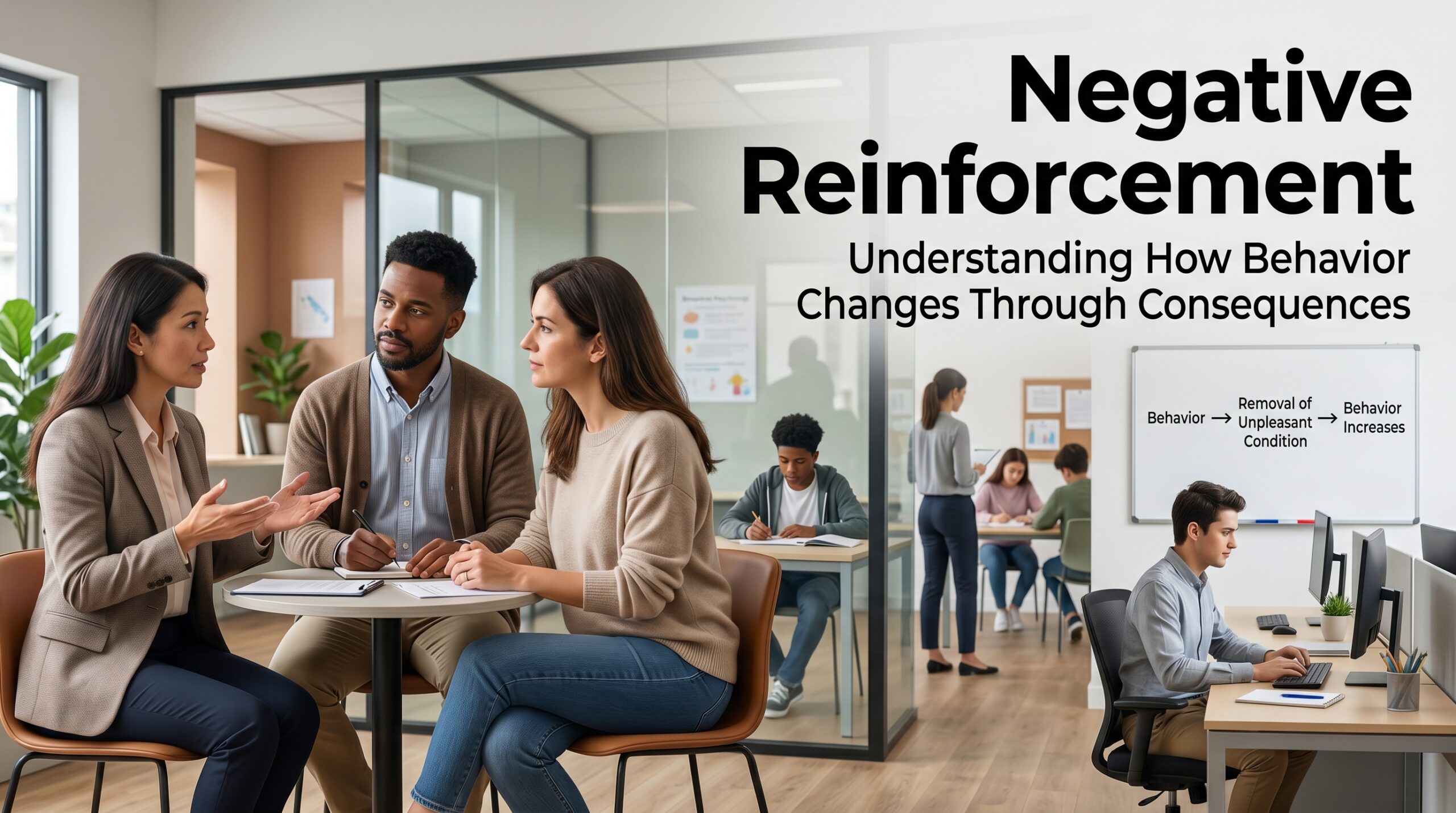
Behavior → Removal of an unpleasant stimulus → Increased likelihood of repeating the behavior
The term negative refers to taking something away. The term reinforcement refers to strengthening a behavior. Together, they describe a process in which behavior grows stronger because an unwanted condition is removed.
Simple Definition
Negative reinforcement is the strengthening of a behavior through the removal of an unpleasant stimulus following that behavior.
Why Negative Reinforcement Matters
Whether we realize it or not, negative reinforcement shapes many of our daily decisions.
People often repeat behaviors because those actions help them avoid inconvenience, discomfort, stress, or unwanted consequences. This principle can be used constructively to encourage responsibility, build habits, and support learning.
Understanding negative reinforcement is valuable for:
- Parents raising independent children
- Teachers managing classrooms
- Managers leading teams
- Coaches developing athletes
- Therapists supporting behavior change
- Individuals building productive habits
When applied correctly, it can encourage positive behavior while reducing conflict and resistance.
 The Science Behind Negative Reinforcement
Negative reinforcement is one of four consequences described in operant conditioning.
| Consequence | Purpose |
| Positive Reinforcement | Increase behavior by adding something desirable |
| Negative Reinforcement | Increase behavior by removing something undesirable |
| Positive Punishment | Decrease behavior by adding something unpleasant |
| Negative Punishment | Decrease behavior by removing something desirable |
A common misconception is that negative reinforcement and punishment are the same. They are not.
The distinction is simple:
- Reinforcement increases behavior.
- Punishment decreases behavior.
This difference is essential for understanding how behavioral strategies work in real-world settings.
How Negative Reinforcement Works
Negative reinforcement follows a predictable sequence:
- An unpleasant condition exists.
- A person performs a behavior.
- The unpleasant condition is removed.
- The behavior becomes more likely to occur again.
Example
A teenager consistently completes household chores without being asked.
As a result, parents stop giving repeated reminders.
Because the reminders disappear, the teenager is more likely to continue completing chores independently.
The desired behavior is strengthened through the removal of an unpleasant condition.
Core Characteristics of Negative Reinforcement
It Increases Behavior
The goal is always to strengthen a desired behavior rather than reduce an unwanted one.
It Involves Removal
Something unpleasant is taken away after the target behavior occurs.
It Relies on Learning Through Consequences
People learn that certain actions help them avoid discomfort or inconvenience.
It Occurs Naturally
Negative reinforcement is not limited to formal behavior programs. It occurs regularly in everyday life.
It Can Be Applied Across Different Settings
The same principle can be used in homes, schools, workplaces, healthcare environments, and athletic programs.
Types of Negative Reinforcement
Behavioral psychologists generally identify two primary forms of negative reinforcement.
Escape Learning
Escape learning occurs when a person performs a behavior to stop an unpleasant stimulus that is already happening.
Example
A loud alarm sounds in the morning.
Pressing the snooze button stops the noise.
Because the action removes the unpleasant sound, pressing the button becomes more likely in the future.
Avoidance Learning
Avoidance learning occurs when a behavior prevents an unpleasant stimulus from occurring at all.
Example
A driver fastens a seatbelt immediately after entering a vehicle.
The warning chime never starts.
Wearing the seatbelt is reinforced because it prevents the unwanted noise.
Real-World Examples of Negative Reinforcement
Parenting
Parents often use negative reinforcement to encourage responsibility and independence.
Examples include:
- Stopping reminders when a child completes homework independently.
- Reducing supervision when a child consistently follows household rules.
- Allowing greater freedom when responsibilities are handled appropriately.
Practical Scenario
A child begins packing their school bag every night without reminders. Once the habit becomes consistent, parents stop checking daily. The removal of monitoring reinforces the responsible behavior.
Education
Teachers frequently use negative reinforcement to promote classroom engagement and self-management.
Examples include:
- Reducing behavior prompts when students consistently follow instructions.
- Granting more independence during projects when students demonstrate responsibility.
- Decreasing monitoring after students establish positive work habits.
Practical Scenario
A teacher no longer needs to remind a student to stay on task because the student consistently completes assignments on time. The reduced monitoring reinforces the desired behavior.
Workplace Management
Effective leaders often apply negative reinforcement in subtle ways.
Examples include:
- Reducing supervision for reliable employees.
- Eliminating frequent progress reports once performance standards are consistently met.
- Granting greater autonomy to teams that demonstrate accountability.
Practical Scenario
An employee consistently meets project deadlines. As trust increases, the manager reduces check-ins, making the employee more likely to maintain high performance.
Healthcare
Healthcare providers may use negative reinforcement to support treatment adherence.
Examples include:
- Following physical therapy recommendations to reduce pain.
- Taking medication consistently to avoid symptoms.
- Completing rehabilitation exercises to regain independence.
In these situations, the reduction of discomfort can reinforce healthy behaviors.
Sports and Athletic Training
Coaches often use negative reinforcement to improve performance and discipline.
Examples include:
- Reducing corrective drills once athletes demonstrate proper technique.
- Eliminating extra conditioning when performance standards are met.
- Providing greater independence during practice after consistent effort.
Athletes learn that disciplined behavior helps them avoid additional corrective measures.
Benefits of Negative Reinforcement
When applied appropriately, negative reinforcement offers several advantages.
Encourages Positive Behavioral Change
People are motivated to repeat actions that help them avoid discomfort or inconvenience.
Supports Habit Formation
Repeated reinforcement can contribute to lasting behavioral patterns.
Promotes Independence
As individuals become more responsible, external monitoring can gradually decrease.
Reduces Reliance on Punishment
The focus shifts from correcting mistakes to reinforcing successful behavior.
Enhances Learning
People learn how their actions influence outcomes, improving self-awareness and accountability.
Improves Motivation
Relief from an unpleasant condition can be a powerful motivator, especially when paired with clear expectations.
Challenges and Limitations
Despite its usefulness, negative reinforcement is not universally effective.
It Is Often Misunderstood
Many people mistakenly use punishment while believing they are using reinforcement.
Consistency Is Critical
Behavioral change weakens when reinforcement is applied inconsistently.
Motivation May Become Avoidance-Based
Some individuals may focus primarily on avoiding discomfort rather than pursuing meaningful goals.
Excessive Pressure Can Be Counterproductive
If the unpleasant stimulus is too intense, it may create anxiety, resistance, or resentment.
Individual Responses Vary
What motivates one person may not motivate another.
Negative Reinforcement vs. Positive Reinforcement
Both strategies increase behavior, but they do so in different ways.
| Feature | Positive Reinforcement | Negative Reinforcement |
| Method | Adds something desirable | Removes something undesirable |
| Goal | Increase behavior | Increase behavior |
| Example | Praise for good work | Reduced supervision for good work |
| Primary Motivation | Reward | Relief |
In many situations, combining both approaches produces stronger and more sustainable results than using either one alone.
Negative Reinforcement vs. Punishment
Confusing these concepts can lead to ineffective behavior management.
| Feature | Negative Reinforcement | Punishment |
| Purpose | Increase behavior | Decrease behavior |
| Outcome | Behavior becomes more frequent | Behavior becomes less frequent |
| Method | Remove an unpleasant condition | Introduce or remove consequences to discourage behavior |
Example
- Removing reminders after homework is completed is negative reinforcement.
- Assigning additional chores for incomplete homework is punishment.
Although both involve consequences, their goals are entirely different.
Factors That Influence Success
Several variables affect whether negative reinforcement will produce the desired outcome.
Timing
The unpleasant condition should be removed immediately after the target behavior whenever possible.
Consistency
People learn more effectively when expectations and consequences remain predictable.
Clarity
The desired behavior should be clearly defined and easy to understand.
Fairness
The unpleasant stimulus should be reasonable and proportionate.
Ongoing Assessment
Behavioral strategies should be reviewed regularly to ensure they remain effective.
Best Practices for Using Negative Reinforcement
Professionals who work in behavior management often recommend the following guidelines:
- Clearly identify the behavior you want to strengthen.
- Remove the unpleasant stimulus promptly after the behavior occurs.
- Keep expectations realistic and achievable.
- Use reinforcement consistently.
- Pair negative reinforcement with positive reinforcement whenever appropriate.
- Focus on long-term learning rather than short-term compliance.
- Adjust strategies based on individual needs and progress.
The most effective reinforcement systems help people develop skills, confidence, and independence over time.
Common Mistakes to Avoid
Mistaking Punishment for Reinforcement
This is the most common error and often leads to ineffective results.
Reinforcing the Wrong Behavior
Unintended consequences can sometimes strengthen behaviors that were not meant to be encouraged.
Being Inconsistent
Changing expectations frequently can weaken learning.
Creating Excessive Discomfort
An unpleasant stimulus should motivate change, not create fear or distress.
Ignoring Positive Reinforcement
Recognition, encouragement, and rewards often strengthen the effectiveness of behavioral interventions.
Expecting Immediate Change
Meaningful behavior change usually requires repetition and patience.
The Future of Behavioral Reinforcement
As psychology, education, and technology continue to evolve, reinforcement strategies are becoming more personalized and data-driven.
Emerging applications include:
- Adaptive learning platforms
- Behavioral health technologies
- Digital coaching systems
- Workplace performance analytics
- Autism intervention programs
- Personalized educational support tools
- Employee development systems
These innovations allow reinforcement strategies to be tailored more closely to individual needs, improving both effectiveness and engagement.
Frequently Asked Questions
What is negative reinforcement in simple words?
Negative reinforcement strengthens a behavior by removing something unpleasant after the behavior occurs.
Is negative reinforcement a punishment?
No. Punishment aims to reduce behavior, while negative reinforcement aims to increase behavior.
Why is it called “negative”?
The term refers to removing something, not to something harmful or negative in nature.
What is the most common example of negative reinforcement?
Wearing a seatbelt to stop or prevent a warning alarm is one of the most widely recognized examples.
Is negative reinforcement effective?
Yes, when used appropriately and consistently, it can be an effective tool for encouraging desired behaviors.
Can negative reinforcement be used in classrooms?
Yes. Teachers often reduce reminders, supervision, or corrective prompts when students consistently meet expectations.
Can parents use negative reinforcement at home?
Absolutely. Parents frequently use it by reducing monitoring or reminders when children demonstrate responsibility.
Is negative reinforcement ethical?
When used responsibly and without causing excessive discomfort, it is considered an ethical behavior-management strategy.
What is the difference between escape learning and avoidance learning?
Escape learning stops an unpleasant stimulus that is already occurring, while avoidance learning prevents the unpleasant stimulus from occurring in the first place.
Can negative reinforcement help create habits?
Yes. Consistent reinforcement can strengthen behaviors and contribute to long-term habit development.
Is negative reinforcement used in therapy?
Many behavioral therapies incorporate reinforcement principles to encourage adaptive and productive behaviors.
Does negative reinforcement work in the workplace?
Yes. Greater autonomy, reduced oversight, and fewer corrective interventions can reinforce strong performance and accountability.
Important!
Negative reinforcement is a foundational concept in behavioral psychology that explains how behavior can be strengthened through the removal of unpleasant conditions. Although the term is frequently misunderstood, it is not a form of punishment. Instead, it is a learning mechanism that encourages people to repeat behaviors that lead to relief, convenience, or improved outcomes.
When used thoughtfully, negative reinforcement can support responsibility, independence, learning, and personal growth. Its effectiveness depends on consistency, fairness, clear expectations, and an understanding of the behavior being targeted.
Whether applied in parenting, education, healthcare, therapy, sports, or workplace settings, negative reinforcement remains a valuable tool for encouraging meaningful and lasting behavior change. The most successful approaches combine it with positive reinforcement, creating supportive environments where people can learn, improve, and thrive.